

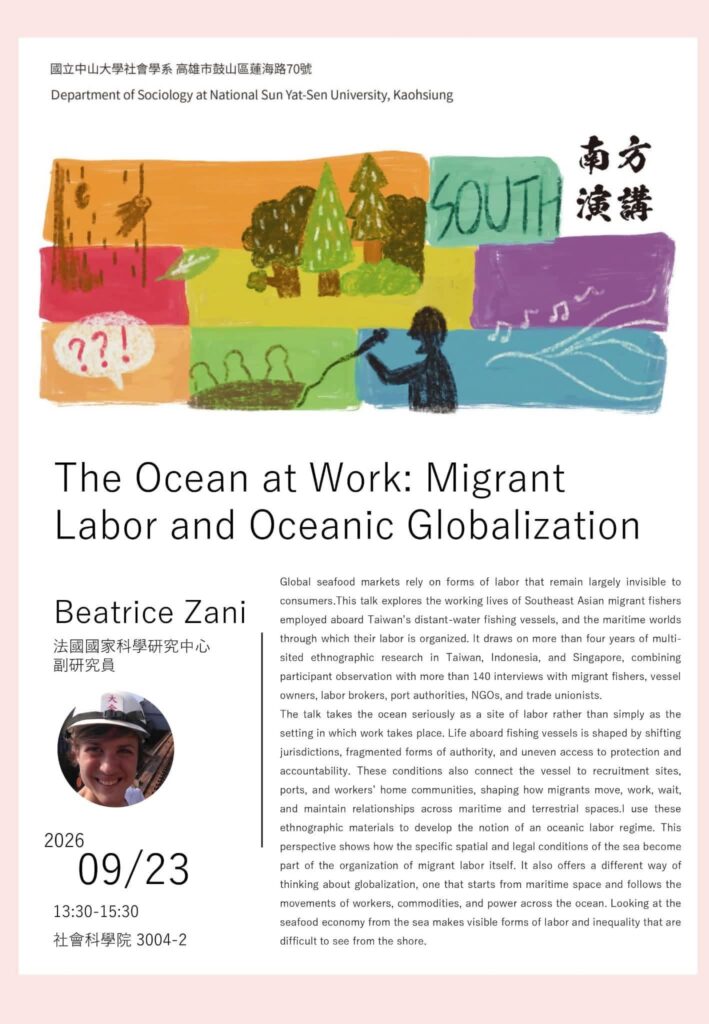
 時間:2026年9月23日(三)下午1點30分至3點30分
地點:社科院3004-2
演講人:Beatrice Zani(法國國家科學研究中心副研究員)
演講簡介:
海鮮上桌以前,誰在海上工作?
住在高雄,我們對港口、漁船和海產都不陌生。但遠洋漁船一離開港口,船上的世界便離我們很遠。
在台灣的遠洋漁船上,有許多來自印尼及其他東南亞國家的漁工。他們怎麼來到台灣、怎麼上船?一連幾個月待在海上,薪資、工時或安全出了問題,又該找誰處理?
事情很難只在船上說清楚。漁工從家鄉出發,經過仲介招募,再到港口登船;漁船則穿越不同海域,受到不同國家的法律管轄。船東、仲介、船長、港口與政府都在其中扮演角色,權力彼此交疊,責任有時也就在這些環節之間被推來推去。
9月23日的南方演講,我們邀請法國國家科學研究中心副研究員 Beatrice Zani,談她對台灣遠洋漁船與東南亞移工的研究。
為了理解這套複雜的勞動世界,她花了四年多的時間往返台灣、印尼與新加坡,進入不同的港口及勞動現場,訪談超過140位漁工、船東、仲介、港務人員、NGO工作者與工會成員。
她將研究中看到的現象稱為「海洋勞動體制」。這個概念聽起來有點硬,問的其實都是很現實的事:當工作場所漂在海上,法律怎麼追得上?當一艘船跨過不同國家的邊界,誰有權管理,誰又必須負責?
這場演講會從漁工的工作與生活出發,帶我們看看一艘遠洋漁船如何連結印尼的招募地、台灣的港口、遠方的漁場,以及我們每天接觸的海鮮市場。
如果你對移工、勞動、海洋或全球化有興趣,歡迎一起來聽。
Global seafood markets rely on forms of labor that remain largely invisible to consumers. This talk explores the working lives of Southeast Asian migrant fishers employed aboard Taiwan’s distant-water fishing vessels, and the maritime worlds through which their labor is organized. It draws on more than four years of multi-sited ethnographic research in Taiwan, Indonesia, and Singapore, combining participant observation with more than 140 interviews with migrant fishers, vessel owners, labor brokers, port authorities, NGOs, and trade unionists.
The talk takes the ocean seriously as a site of labor rather than simply as the setting in which work takes place. Life aboard fishing vessels is shaped by shifting jurisdictions, fragmented forms of authority, and uneven access to protection and accountability. These conditions also connect the vessel to recruitment sites, ports, and workers’ home communities, shaping how migrants move, work, wait, and maintain relationships across maritime and terrestrial spaces.
I use these ethnographic materials to develop the notion of an oceanic labor regime. This perspective shows how the specific spatial and legal conditions of the sea become part of the organization of migrant labor itself. It also offers a different way of thinking about globalization, one that starts from maritime space and follows the movements of workers, commodities, and power across the ocean. Looking at the seafood economy from the sea makes visible forms of labor and inequality that are difficult to see from the shore.


近期留言